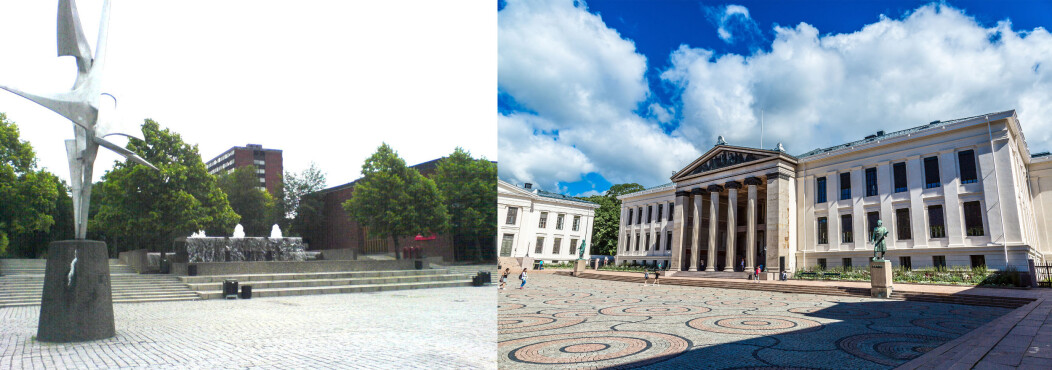
Blindern og Urbygningen (Foto: Wikimedia og Colourbox)
Postdoctoral Research Fellow in Rhythm and Music Production
Deadline: 01.02.2024
Publisert
Universitetet i Oslo
The University of Oslo is Norway’s oldest and highest ranked educational and research institution, with 28 000 students and 7500 employees. With its broad range of academic disciplines and internationally recognised research communities, UiO is an important contributor to society.
RITMO Centre for Interdisciplinary Studies in Rhythm, Time and Motion is financed through the Research Council of Norway’s Centre of Excellence Scheme.
RITMO combines a broad spectrum of disciplines – from musicology, neuroscience and informatics – to study rhythm as a fundamental property of human cognition, behaviour and cultural expression. The Centre is organized under the Department of Musicology, in close collaboration with the Department of Psychology and the Department of Informatics.
RITMO is a Centre of Excellence funded by the Research Council of Norway. This interdisciplinary centre focuses on rhythm as a structuring mechanism for the temporal dimensions of human life. Methods from musicology, psychology, neuroscience, and informatics are combined to study rhythm as a fundamental property that shapes and underpins human cognition, behaviour and cultural expressions.
All RITMO researchers are co-located and work in a unique interdisciplinary constellation, with world-leading competence in musicology, psychology, and informatics. It is expected that all members of the centre contribute to the general activities and collaborations within RITMO. The researchers have access to state-of-the-art facilities in sound/video recording, motion capture, eye tracking, physiological measurements, various types of brain imaging (EEG, fMRI), and rapid prototyping and robotics laboratories.
Job description
The Postdoctoral Research Fellow is expected to investigate rhythm and groove in groove-based musical genres from a music production research perspective. Methods may involve various types of music analysis/interpretation, interviews, fieldwork, or similar. Projects that engage with hip-hop, pop, or electronic music, as well as the emerging trend of AI-based production tools, are highly encouraged.
The project will be part of an overall thematic area focused on timing, expectations, and attention in complex rhythmic contexts.
Applicants should upload a research outline (ritmo.uio.no), with research questions and theoretical and methodological approaches.
The appointment is for a period of three years, starting 1. September 2024. There is a 10 % component of the position which is devoted to teaching and administrative duties. There might be a possibility to extend to four years depending on the qualifications of the recruited candidate, the departments’ needs for teaching, and the centre’s need for assistance.
The successful candidate is expected to be part of the research environment of RITMO and contribute to strengthening the links between different research areas within the centre. The main purpose of postdoctoral research fellowships is to qualify researchers for work in higher academic positions within their disciplines.
Qualification requirements
A PhD degree or equivalent in musicology, popular music studies, music production, music technology, or another relevant field. The applicant is required to document that the degree corresponds to the profile for the post.
Practical and/or academic knowledge of groove-based genres and music production.
Experience with one or more of the following methods is also advantageous: music analysis, interviews, fieldwork, and artistic or technical research into rhythm and/or music production.
Excellent skills in written and oral English
Personal suitability and motivation for the position.
The doctoral dissertation must be submitted for evaluation by the application deadline. The appointment is dependent on the public defence of the doctoral thesis being approved.
In the evaluation of the applications, emphasis will be placed on:
The research project’s scientific merit, research-related relevance and innovation, and its relevance to the research objectives of RITMO
The applicant’s estimated academic and personal ability to carry out the project within the allotted time frame and contribute to the overall research at RITMO
Excellent collaboration skills and the ability to successfully join in academic teamwork within and across disciplines.
We offer
Salary NOK 575 400 – 657 300 per annum depending on qualifications
Application letter describing the applicant’s qualifications, how it corresponds to the profile for the post, and motivation for the position
Curriculum Vitae (complete list of education, positions, teaching experience, administrative experience and other qualifying activities, including a complete list of publications with links to the full version of published papers)
Research outline, including relevant research questions and theoretical and methodological approaches (approximately 2-3 pages, see the template for research outline)
Names and contact details of 2-3 references (name, relation to candidate, e-mail and telephone number)
Diplomas, certificates, doctoral thesis and other academic works will be requested later.
Please note that all documents must be in English or a Scandinavian Language.
The application with attachments must be delivered in our electronic recruiting system, jobbnorge.no.
The short-listed candidates will be invited to an interview.
Formal regulations
Please see the guidelines and regulations for appointments to Postdoctoral fellowships at the University of Oslo.
No one can be appointed for more than one Postdoctoral Fellow period at the University of Oslo.
Following the Freedom of Information Act (Offentleglova) § 25, Chapter 2, information about the applicant may be used in the public list of applicants even if the applicant opts out from the entry in the public application list.
The University of Oslo has an Acquisition of Rights Agreement for the purpose of securing rights to intellectual property created by its employees, including research results.
Inclusion and diversity are a strength. The University of Oslo has a personnel policy objective of achieving a balanced gender composition. Furthermore, we want employees with diverse professional expertise, life experience and perspectives.