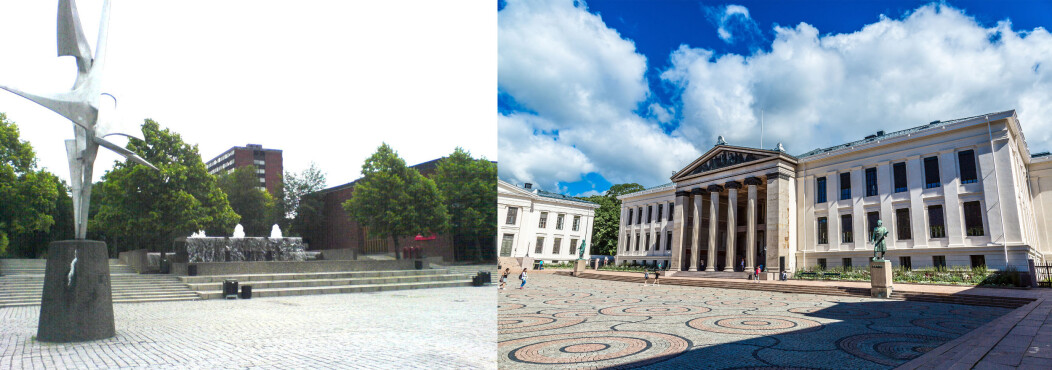
Blindern og Urbygningen (Foto: Wikimedia og Colourbox)
Associate Professor in Meteorology
Deadline: 01.02.2024
Publisert
Universitetet i Oslo
The University of Oslo is Norway’s oldest and highest rated institution of research and education with 28 000 students and 7000 employees. Its broad range of academic disciplines and internationally esteemed research communities make UiO an important contributor to society.
The geosciences are the studies of the planet Earth and its comparative planetology; the atmosphere, the hydrosphere and cryosphere, the Earth's surface and its interior. The Department of Geosciences conducts research and teaching in most of the domains of geoscience; geology, geophysics, physical geography, geomatics, hydrology, meteorology and oceanography. The Department is the broadest geoscience research and education environment in Norway. We perform research at a high international standard and have five ERC (European Research Council) research projects ongoing.
The Department encompasses six scientific sections; Meteorology and Oceanography, Geography and Hydrology, Study of sedimentary basins, Environmental geosciences. and Crustal Processes. We host now a third in the line of three Centre of Excellences: PHAB – Centre for Planetary Habitability, and have a Norwegian Research School for PhD students (Research School for Dynamics and Evolution of Earth and Planets, DEEP).
The Department aims to contribute to the new and important UN Sustainability Development Goals, and are important contributors to IPCC (UN’s Inter-governmental Panel on Climate Change). The staff consists of 40 professors and associate professors, in addition to postdoctoral fellows, PhD students, researchers, technical- and administrative staff. The Department has around 200 employees.
About the Department and the position
A full-time position as Associate Professor in Meteorology is available at the Department of Geosciences, University of Oslo, Norway.
The Department of Geosciences (GEO) at the University of Oslo (UiO) is part of the Faculty of Mathematics and Natural Sciences (MATNAT) and is a leading research unit in Europe. The Department covers a wide breadth of topics, from mantle and lithosphere dynamics on Earth and other planets, via surface processes in the boundary layers between Earth’s surface and atmosphere, to the dynamics and interactions in the Earth's crust, soils, hydrosphere, atmosphere, and biosphere. The Department of Geosciences has defined a strategy that focuses on four main topics that are transversal to the Department: (i) Dynamics of the solid Earth and planets, (ii) Climate change and the coupled Earth system, (iii) Environmental geosciences, and (iv) Geoscience in the Arctic. The Department aims to contribute to the United Nations (UN) Sustainability Development Goals and hosts important contributors to IPCC (UN’s Inter-governmental Panel on Climate Change). The staff consists of c. 40 professors and associate professors, in addition to postdoctoral fellows, PhD students, researchers, technical and administrative staff. In total, the Department today hosts around 200 employees, one Centre of Excellence and, at present, five grants from the European Research Council, along with numerous other grants from public and private institutions. The Department is organised in six sections: (i) Basin studies, (ii) Crustal processes (iii) Centre for Planetary Habitability (PHAB, Centre of Excellence), (iv) Environmental Geoscience, (v) Physical Geography and Hydrology (GeoHyd), and (vi) Meteorology and Oceanography (MetOs). A small group working towards geo-didactics is also organised in a section as the UiO part of the Centre for Excellence “iEarth”.
The position is associated with the MetOs section at the Department of Geosciences, which today consists of 5 permanent staff and ca. 30 employees in total.
General information about the position
We are looking for a Meteorologist with broad experience in atmospheric dynamics. This could include all scales, from the planetary to synoptic, mesoscale, and boundary layer scales.
Many of today's biggest societal challenges require a thorough understanding of the dynamics of the atmosphere. This improves our ability to create reliable and accurate weather forecasts, to project future climate change and to design future renewable energy systems. UiO has a long history in atmospheric dynamics, but currently lacks central expertise in this field.
The position will be an important link to research and education in related fields, such as oceanography, hydrology, geohazards and the Earth system in a broad sense. Because atmospheric dynamics is so crucial for the Earth system, the expectation is that the position will make it easier for activities related to weather, water, energy and climate at UiO to develop into projects and applications across disciplines — with atmospheric dynamics as an important common denominator.
UiO has a particular responsibility for increasing the understanding of Arctic climate change, which is occurring faster than anywhere else on the planet. High and mid-latitude weather and climate are strongly influenced by transport of heat in the atmosphere and ocean, as well as by regional processes. The announced position will be an important link in the strengthening of polar climate research at UiO.
Research: The successful candidate is expected to
specialize in the dynamics of the atmosphere across scales.
have a focus on processes relevant for mid- and high latitudes.
work on problems related to both weather and climate.
The successful candidate is expected to work across spheres, collaborating with other researchers in meteorology, oceanography, hydrology, glaciology or ecology at UiO, and also with external research environments both nationally and internationally. The Department of Geosciences contributes to various national and local infrastructure, such as INES (Infrastructure for the Norwegian Earth System Model), eddy-covariance flux towers, drones, and a climate container for performing experiments under controlled cold climate conditions. The successful candidate is encouraged to employ one or more of these infrastructures in their research plans.
Education: The successful candidate is expected to
take responsibility for two courses, preferably one at bachelor's level and one at master's level. The design of the courses will be influenced by the competence of the candidate employed, but at present there is a particular need for teaching in “Introduction to Meteorology” (Bachelor level) and “Dynamic Meteorology” (Master level).
further develop the course portfolio in the department and facilitate research-based education in collaboration with various sections and research groups.
supervise bachelor's, master's and PhD students.
Qualification requirements
Assessment of candidates will be based on scientific and educational excellence, as for example reflected in the number and quality of peer-reviewed publications, scientific relevance, ability to attract external funding, and other evidence of impact. The main emphasis will be on the candidate’s performance during the last five years.
The candidate must have a PhD in meteorology, oceanography, physics, applied mathematics or a related field.
The candidate must have experience in research and education within atmospheric dynamics.
The candidate is expected to have a scientific record of accomplishment at a high international level and to demonstrate the ability to attract external funding and lead research projects.
Teaching and supervision experience at all levels will be an important factor in the evaluation process and must be well documented in a teaching portfolio. The applicant should describe their qualifications in view of the Scholarship of Teaching and Learning (SoTL) framework which includes:
Focus on student learning
A clear development over time
A researching approach
A collegial attitude and practice
The successful candidate who at the time of appointment cannot document sufficient teaching qualifications (minimum formal requirement is a 200 hours pedagogical programme) will be required to obtain such qualifications within a two-year period.
The successful candidate must demonstrate mastery of both English and one of the Scandinavian languages as working languages, in order to be able to teach and otherwise be able to participate in all functions the position may involve. If the successful candidate does not have sufficient mastery of a Scandinavian language, the candidate will be required to learn sufficient Norwegian within a two-year period.
Desired qualifications:
Experience in the following is advantageous:
theory, modelling and observations,
interdisciplinary research,
international collaboration,
outreach activities.
Personal qualities
The candidate must be creative and innovative in their research and able to initiate new activity in line with the department's strategy. The person must be a team player, have good communication skills and a desire to contribute to a good and inclusive work environment. We also emphasize good written and oral presentation skills, the ability to communicate new and complex information effectively and to engage the target groups. We highlight teamwork and internal cooperation as a success factor for funding application and work environment development.
We offer:
Salary NOK 692 400 - 777 900 per year depending on qualifications in a position as Associate Professor (position code 1011).
A professionally stimulating work environment.
Attractive welfare benefits and a generous pension agreement, in addition to Oslo’s family-friendly environment with its rich opportunities for culture and outdoor activities.
The opportunity to apply for promotion to full professorship at a later stage.
How to apply
The application must include:
Application letter.
A research statement (1–4 pages) describing the applicant’s vision, research and teaching ambitions for the nearest future.
A detailed CV, including a complete list of education, positions, pedagogical experience, administrative experience, project acquisition and coordination experience, and other qualifying activities.
Copies of educational certificates, PhD diploma, transcript of records and letters of recommendation.
A complete list of publications and academic merits and awards (if not included in the CV).
Full text of up to 10 selected scientific publications the applicant wishes to include in the evaluation along with a description of the importance, interrelation, and relevance of the selected papers for this position.
Educational portfolio of 3–6 pages documenting educational competence and experience, including a reflection note in which your own teaching practice and view of learning is anchored in the SoTL framework.
List of reference persons who may be contacted by the Department of Geosciences: 2–3 references (name, relation to candidate, e-mail and phone number).
The application with attachments must be submitted in our electronic recruiting system; please follow the link “Apply for this job”. Please note that all documents should be in English (or a Scandinavian language).
Formal regulations
As a general rule an interview will be used in the appointment process, usually supplemented with a trial teaching session. The basis for assessment will be the scientific production of the applicant, the teaching portfolio, pedagogical and educational qualifications, the applicant’s qualifications within leadership and administration, other qualifications as well as general personal suitability for the position. In ranking the competent applicants, the full range of qualifications will be considered and explicitly assessed.
Rules for appointments to associate professorships.
Rules for the assessment and weighting of pedagogical competence for appointments to permanent academic posts which include teaching duties, check here.
According to the Norwegian Freedom and Information Act (Offentleglova), information about the applicant may be included in the public applicant list, also in cases where the applicant has requested non-disclosure.
The University of Oslo aims to achieve a balanced gender composition in the workforce and to recruit people with ethnic minority backgrounds. Women are encouraged to apply.
The University of Oslo has an agreement for all employees, aiming to secure rights to research results, see here.
In addition, the University of Oslo aims for its employees to reflect the diversity of the population to the greatest degree possible. We therefore encourage qualified applicants with disabilities or gaps in their CV to apply for the position. The University of Oslo will adapt the workplace to suit employees with disabilities. Applicants who indicate that they have disabilities or gaps in their CV are made aware that this information may be used for statistical purposes.
Contact information
For further information please contact:
Kirstin Krüger, Section leader MetOs, Department of Geosciences, email: kkrueger@geo.uio.no